The Marketing-Sales Alignment Gap Is Costing You Deals
Marketing Creates the Story. Sales Tells a Different One. Buyers Notice.
Marketing spends months building a value narrative. Messaging frameworks. Campaign assets. Demo scripts. A content library that would make any analyst smile. And then sales does what sales does: ignores most of it, goes off-script, and tells whatever story feels right in the moment.
The buyer gets three different value propositions from three different reps. The carefully crafted differentiation evaporates. And another deal stalls because no one could agree on what you actually stand for.
This isn’t a people problem. It’s a systems problem. And it’s one of the most expensive inefficiencies in B2B revenue.
The Handoff Is Where Value Goes to Die
The gap between marketing and sales isn’t just an organizational frustration. It’s a revenue leak. Every piece of content that never gets used. Every value story that gets simplified into oblivion by a rep who didn’t have time to read the brief. Every buyer who received an inconsistent experience and quietly moved on.
The problem is structural. Marketing builds assets. Sales has conversations. And there’s no shared platform ensuring the story that leaves marketing is the same story that arrives at the buyer.
Meanwhile, buyers — who are already doing most of their evaluation independently — need a consistent, compelling narrative at every touchpoint. When they get three versions of your story, they stop trusting any of them.
One Story. Every Channel. Every Rep. Personalized to Every Buyer.
The solution isn’t more training, more content, or more alignment meetings. It’s a single platform where marketing builds the value story and sales delivers it — interactively, personally, and consistently — to every buyer at every stage of their journey.
When the interactive experience marketing creates is the same one sales puts in front of a buyer, the value story survives. Reps stop improvising. Buyers get a coherent narrative. And the investment marketing makes in building the story actually shows up in revenue.
“Kaon is the platform where marketing and sales finally tell the same story.“
The Numbers Don’t Lie
Explore Our Insights
blog
Future-Proofing Leadership with Digital Transformation
Featured in The B2B Engagement Podcast
news

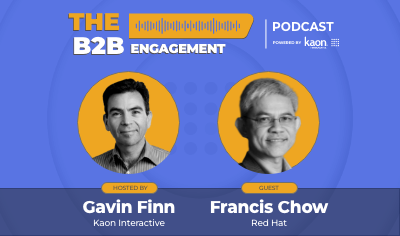
How to Leverage AI in the C-Suite
Featured in Sales & Marketing Management
news

Cultivating Company Culture for Innovation
Featured in The B2B Engagement Podcast
news

Are Company Leaders Keeping Up with AI?
Featured in Schwab Network
news

Orchestrating Marketing’s Various Channels
Featured in The B2B Engagement Podcast
news


Kaon Interactive Wins 2023 Communicator Award of Excellence
Featured in Martech Cube
news

Creating a Frictionless B2B Engine
Featured in The B2B Engagement Podcast
news

The Future of Work & Meetings in 2023 is Hybrid Collaboration
Featured in Tech Times
news

press release

press release


press release
FAQ
Misalignment typically stems from separate tools, separate goals, and no shared platform for delivering the value story. Marketing optimizes for content creation and lead generation; sales optimizes for closing. Without a unified system, the story fractures in the handoff.
A shared platform ensures that the value narrative marketing builds is the exact same experience sales delivers — personalized for each buyer, consistent across every rep, and measurable at every stage. It eliminates the improvisation that kills value stories in the field.
A value-selling platform is a technology solution that enables marketing to build interactive, buyer-centric experiences and sales to deliver them — without customization, without version control problems, and without the story getting lost. It’s the connective tissue between marketing investment and sales outcomes.
In 2026, an interactive demo is defined as a hands-on, guided experience that allows a prospect to explore a product’s value without a live production environment or a sales rep present.
- Active Participation: Unlike a video, where the user is passive, an interactive demo requires clicks, inputs, and navigation.
- Replica Environments: These demos use “Digital Twins” or HTML/CSS captures to mirror the real product experience, maintaining dynamic elements like hover states and real-time data visualizations.
- Agentic Guidance: Advanced platforms like Demo360.ai now include AI-driven “agents” that act as 24/7 guides, answering technical questions within the demo itself.
Interactive platforms have moved beyond the “Marketing-only” silo. In 2026, 78% of organizations use interactive demos in two or more use cases.
- Sales & Presales: To lead complex technical discussions or provide “leave-behind” environments for the 13+ stakeholders in an enterprise buying committee.
- Product Marketing: To launch new features globally and ensure consistent messaging across all regions.
- Events & Field Marketing: To show a full catalog of heavy equipment at a trade show without the cost of shipping physical assets.
- Customer Success: To create “Aha! moment” walkthroughs that accelerate onboarding and reduce support tickets.
While timelines vary by complexity, 2026 benchmarks show a significant shift toward speed-to-market.
- Standard Walkthroughs: Simple click-through tours can often be captured and launched in 2 weeks.
- Enterprise Digital Twins: For complex hardware or multi-path software simulations (typical of the Kaon platform), a pilot project usually takes 4 to 6 weeks from storyboard to global deployment.
Yes—and they must be.
- The High Velocity Model: Kaon’s platform includes a unique maintenance model where application updates (to keep up with OS or browser changes) are handled at no additional cost.
- Modular Updates: Modern platforms allow you to swap out specific “chapters” or 3D modules without rebuilding the entire experience.
- Living Documentation: Mature teams update their demos weekly or monthly. Those that do report significantly higher impact than those that only update during major product releases
Absolutely. While Kaon supports some of the largest global enterprises, its platform is designed for scalability.
- Start Small, Scale Fast: Lean teams often begin with a “Hero Demo” for their flagship product and expand as they see the ROI (like the $1.2M annual savings reported by Ricoh).
- AI Assistance: AI-powered tools within the platform (like Demo360.ai) allow small teams to generate talk tracks, translations, and technical FAQs without needing a large creative agency.
-
Predictable ROI: Even in a pilot phase, the elimination of just one or two physical freight shipments often covers the entire initial investment in the digital platform.
Contact Us
Get Started with Kaon
Interested in learning more? Let’s start a conversation →