How B2B Marketing & Sales Leaders Deliver More With Less, Without Sacrificing Results
The C-Suite Wants More Pipeline, Better Win Rates, and Lower Cost. You Need a Way to Deliver All Three.
The mandate has never been clearer or more contradictory. Do more. Spend less. Show the numbers. Justify every dollar. Deliver pipeline that converts. Enable a sales team that keeps growing. And do it all with a headcount that isn’t.
If you’re waiting for budget relief, it’s not coming. The question isn’t whether you can do more with less. It’s whether you have the right platform to make it possible.
See How Kaon Helps You Do More With Less →
The Point Solution Trap
Most marketing and sales teams are sitting on a stack of disconnected tools, agency relationships, and custom builds, each solving one problem, none talking to each other, and all requiring ongoing budget to maintain. You’re paying for a content agency. A sales enablement tool. A demo environment. A web experience platform. And none of them are driving the outcomes the C-Suite is asking for.
The cost isn’t just financial. It’s operational. Every new point solution adds complexity, creates alignment challenges, and produces another set of metrics that don’t connect to revenue. And when budget scrutiny hits, none of them can defend themselves clearly enough to survive.
Consolidate, Scale, and Prove It
The B2B teams that thrive under budget pressure aren’t cutting their way to efficiency. They’re consolidating onto platforms that do more — more channels, more markets, more buyer touchpoints — from a single investment. They’re building experiences once and deploying them everywhere. They’re measuring engagement, adoption, and revenue impact in a single view.
And when the C-Suite asks “what did marketing contribute to the pipeline this quarter?”, they have an answer.
“Kaon is built for exactly this moment. One platform. Three capabilities. Measurable enterprise impact at every stage.“
One Enterprise Investment. More Impact.
See how leading B2B companies create interactive experiences once and deploy them across web, sales, events, and digital channels.
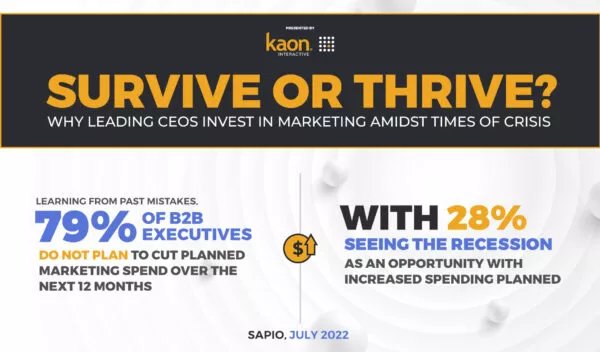
The Numbers Don’t Lie
Explore Our Insights
blog
blog
blog
How AI Drives Revenue Growth
Featured in Digital Marketing News
news

How B2B Marketing Must Drive Revenue
Featured in Sales & Marketing Management
news

news
Navigating the Digital Era: Budgeting for Customer-Centric B2B Sales and Marketing
Featured in Entrepreneur
press release




FAQ
Start with the metrics that matter to the C-Suite: pipeline contribution, win rate, deal velocity, and cost per opportunity. The best marketing technology platforms tie engagement data directly to revenue outcomes — so you can show exactly how a marketing investment influenced a closed deal.
The most scalable approach is a platform where marketing builds the value story once and sales delivers it everywhere — without requiring custom builds, IT involvement, or per-rep customization. Scalability comes from centralized control with distributed delivery.
Interactive experiences replace multiple static assets — physical demos, printed collateral, custom presentations — with a single, reusable digital experience. Companies like Ricoh have documented seven-figure annual savings by making this shift. Beyond cost reduction, they also improve effectiveness — driving higher engagement, better retention, and faster deal cycles.
Interactive demos are no longer optional—they are revenue multipliers. Recent 2025-2026 benchmarks show that shifting from static to interactive content fundamentally changes the math of the sales funnel.
- Accelerated Sales Cycles: Companies typically see a 15% to 25% reduction in sales cycle length as prospects self-qualify faster.
- Conversion Lift: Interactive demo platforms can improve website conversion rates by nearly 8x compared to traditional static “Request a Demo” forms.
- Revenue Outperformance: B2B firms that invest in advanced digital sales experiences are 2.3 times more likely to outperform their peers in revenue growth.
The most efficient B2B organizations in 2026 have moved away from “siloed” content. The strategy is now COPE: Create Once, Publish Everywhere. By using a single interactive platform, companies ensure that their technical story remains consistent across every touchpoint.
- Frictionless Transitions: B2B buyers now use an average of 10+ digital touchpoints (up from 5 just a few years ago) before committing to a purchase. Reusing one demo ensures the technical story remains identical across all 10+ channels.
- Unified Engagement: Buyers engage in an average of 27-28 interactions with a vendor. Using a single Kaon or Demo360.ai application ensures message consistency across all 15 digital and 12 human touchpoints.
- Cost Avoidance: Organizations that maintain separate assets for different departments face a 30% “content waste” tax. Centralizing on one interactive application allows you to reallocate that budget from redundant development to high-impact strategy.
Basic 3D viewers show what a product is; Kaon platforms (including Demo360.ai) explain what a product does for the buyer’s business.
- Agentic Intelligence: Unlike standalone AR apps, Demo360.ai acts as an AI Sales Copilot, answering technical questions and providing real-time guidance during a demo.
- Complex Logic: Kaon applications integrate ROI calculators and workflow simulations that basic visualization tools cannot handle.
- Data Integration: 2026 buyers prioritize Digital Trust. Kaon provides first-party behavioral data that integrates directly into your CRM, while one-off AR apps often remain “black boxes” of data.
In 2026, the key metric is Interaction Depth, not just views.
- Self-Qualification Accuracy: Track how many stakeholders use the demo to validate their specific requirements before the first call.
- Information Retention: Interactive learning delivers 75% retention, compared to 20% for video. Success is measured by “warmth”—how much a buyer already knows when the sales rep arrives.
- Stakeholder Expansion: Successful demos are those that are shared internally. Since buying groups now average 10–13 stakeholders, the number of unique “shares” per demo is a critical KPI for 2026.
Justification in 2026 is built on Buyer Preference and Operational Efficiency.
- AI-First Research: 77% of B2B buyers now depend more on AI-driven tools than traditional search engines for research. Providing a data-rich interactive demo feeds these AI tools the “ground truth” about your product.
- The “Rep-Free” Requirement: 61% of buyers now prefer a “rep-free” experience for the majority of their journey. An interactive demo is the only way to satisfy this demand while still influencing the sale.
- Logistics Elimination: Quantifiable savings from reduced physical freight, drayage, and booth storage costs provide an immediate, CFO-friendly ROI.
Contact Us
Get Started with Kaon
Interested in learning more? Let’s start a conversation →